The Sportscar Vintage Racing Association (SVRA) hosted the U.S. Vintage Racing National Championship at the Circuit of The Americas this weekend, the finale of the season.
GMT Racing and ANSA Motorsports entered Audi race cars for the historic racing event.
Travis Engen was out in force with his GMT Racing prepared Audi R8, chassis #606.
Eric Johnson brought two of his Audi race cars to the circuit, both prepared and run by ANSA Motorsports. His 2006 Audi A4 DTM R12 plus was on the entry list and his second car, the ex-MTM Motorsport Audi R8 LMS that won the 2013 GT Sprint title in Italy, was seen out on track with Johnson behind the wheel.
The weekend's results are not online as of yet, but they will be available on mylaps.com HERE.
Countdown to 82nd running of Le Mans 24 Hours is underway
Prof. Dr. Hackenberg: “Le Mans is a unique test laboratory for new technologies”
Ingolstadt, January 13, 2014 – For 15 years, Audi has been demonstrating ‘Vorsprung durch Technik’ in the world’s toughest endurance race. With the latest generation of the R18 e-tron quattro hybrid race car Audi continues its string of technical innovations at the Le Mans 24 Hours.
In 152 days from now, on June 14, the 82nd running of the French endurance classic will start at 3 p.m. Interest in the event is already exceptionally high. For the first time, Audi and Porsche, the race’s two most successful brands, will be pitted against each other. Toyota, after suffering two defeats against Audi, is aiming to break the four rings’ string of victory at Le Mans. Plus, for the first time, new regulations with a main focus on energy efficiency will be in effect – for Audi, the inventor of the TDI, this will provide an opportunity to again prove its great technical expertise not only on the road but on the race track.
Be it with the engine, hybrid drive, lightweight design, or by setting standards in active and passive safety: Audi’s Le Mans prototypes are front runners in terms of sporting performance as well as technology. “Le Mans is a unique test laboratory for our technologies,” says Prof. Dr. Ulrich Hackenberg, who is responsible for Technical Development on the Board of Management of AUDI AG. “The comprehensive range of new technical developments of our current Le Mans race car includes the headlights with laser light. They illuminate the track for a distance of up to 800 meters. In a planned derivation for production vehicles, they achieve up to 500 meters, which is twice the range of LED headlights. With that, Audi is making an important contribution to safety on the track and in road traffic.”
Advanced engine technologies for maximum efficiency
In 2001, an innovative V8 engine powered the Audi R8. TFSI gasoline direct injection metered the fuel in a way that reduced the consumption of the V8 turbo power-plant, improved responsiveness and, due to the engine’s ability to immediately start again, shortened the stopping times in the pits while making more power output available. Just shortly following the first Le Mans success, Audi’s customers were able to order the first production models featuring gasoline direct injection. This fuel induction principle soon evolved into the standard in large-volume production series. Today, TFSI engines contribute to the reduction of CO2 emissions in millions of cars.
Five years after this debut, Audi showed another pioneering achievement. In the 2006 season, the Audi R10 TDI powered by a direct-injection diesel engine won the endurance classic at La Sarthe right on its first run. Winning Le Mans with a diesel-powered race car had been considered wishful thinking until then – today, it is regular reality. To date, Audi has won the race seven times on TDI power, with learning effects continually being fed into the design of crankcases, pistons, fuel injectors and other assemblies in production development.
e-tron quattro hybrid drive takes Le Mans victory
Audi was the first Le Mans participant to win with a hybrid drive system and therefore again made motorsport history. 2012 saw the first victory of the Audi R18 e-tron quattro, a sports prototype with a rear axle being powered by a TDI internal combustion engine and a front axle driven by electric power. A fully electronic control strategy was the only connection between the two drive systems. In parallel, Audi also expanded its product range by hybrid models.
The next generation is now ready for launch. In 2014, Audi starts delivering the A3 Sportback e-tron, a latest-generation plug-in hybrid. In racing, the new 2014-specification R18 e-tron quattro is pointing the way to the future. The Audi engineers have fundamentally redesigned it, as the race car has to manage both, running on a limited amount of energy and achieving the best lap times.
Highly sophisticated detailed solutions for higher safety and lower weight
In addition to the pioneering powertrain solutions, Audi has been setting standards in other areas as well. Perfect lightweight design combined with maximum passive safety is manifested in the safety cell of the sports cars. The monocoque made of carbon fiber reinforced plastics (CFRP) in 2013 weighed only half as much as the one used in Audi’s first LMP race car in 1999 – despite greater restrictions specified by the regulations. This material has long made its way into production vehicles, for instance in body components of the R8, the R8 Spyder and the RS 3. Active safety has been significantly improved by Audi with ever new lighting technologies. The LED daytime running light in the Audi R10 TDI (2006–2008) was followed by full LED headlights in the R18 TDI (2011), matrix LED technology in the R18 e-tron quattro (2012–2013) and the innovative laser light in the next R18 e-tron quattro (from 2014). The digital rear-view mirror with a camera projecting the action at the rear on an innovative AMOLED display in the cockpit, which has been used since the 2012 season, reflects another future trend.
“The general public and the motorsport audience have come to expect Audi to play this part of a trendsetter,” says Head of Audi Motorsport Dr. Wolfgang Ullrich. “We are proud to be at the very front with these innovations in our motorsport commitment, while benefiting from Audi Sport being a part of the Technical Development of AUDI AG on a daily basis. We aim to continue to prove the Audi-typical ‘Vorsprung durch Technik’ in tough racing conditions with our Le Mans prototypes in the future – even though in 2014 we’re no doubt facing the greatest challenge ever at Le Mans.”
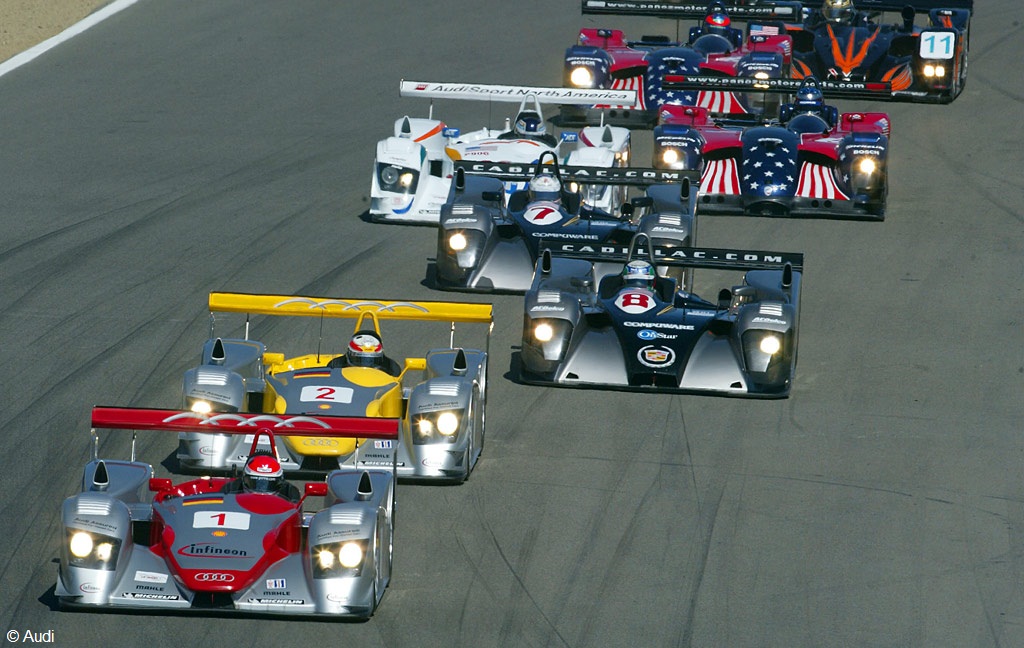
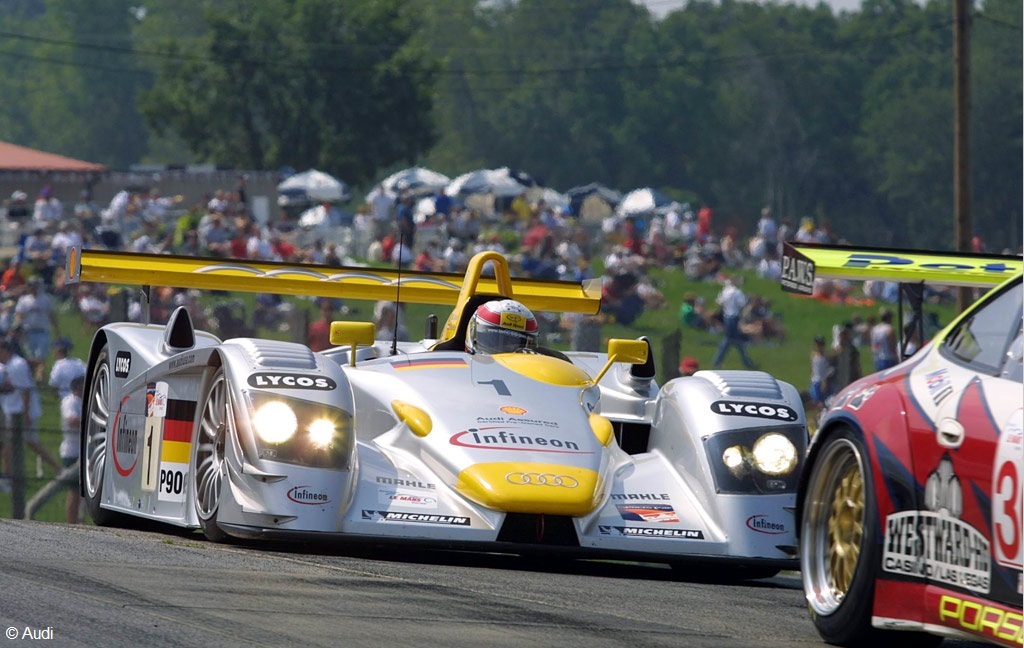
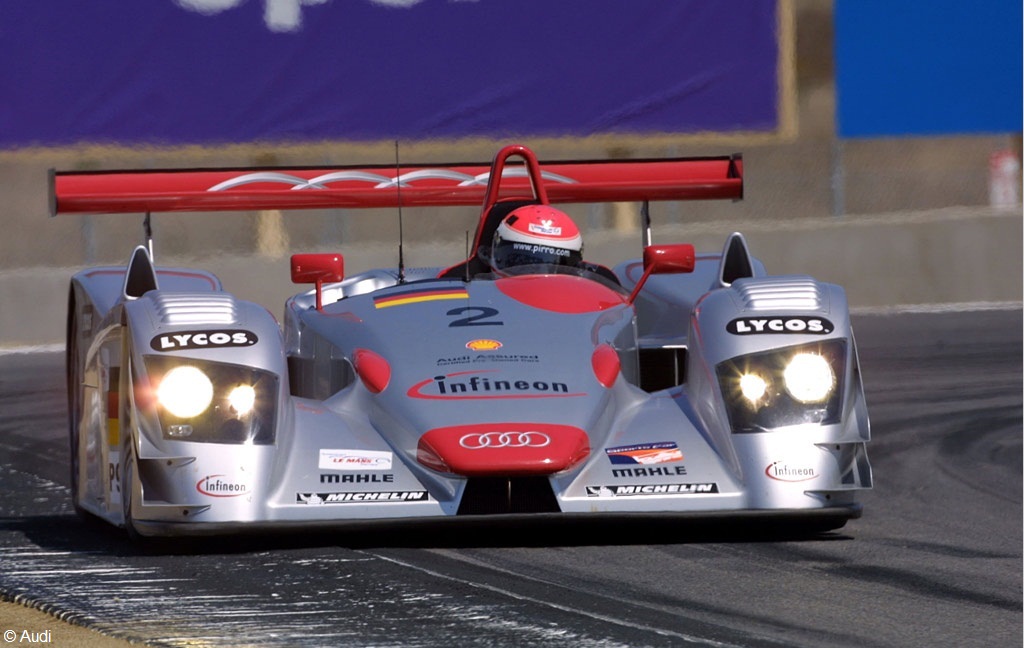
After two very successful seasons in the American Le Mans Series, Audi would again come back in 2002, as the defending champions with their all-conquering Audi R8 cars. Thrilling battles all season long between the Audis and against the competitive Panoz team and a growing Cadillac effort.
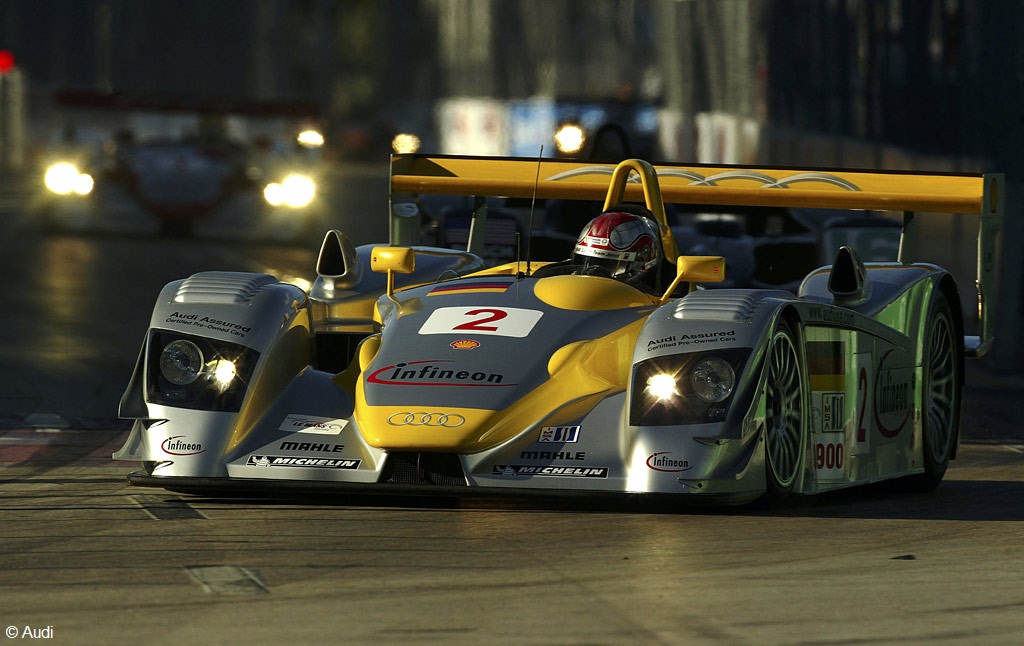
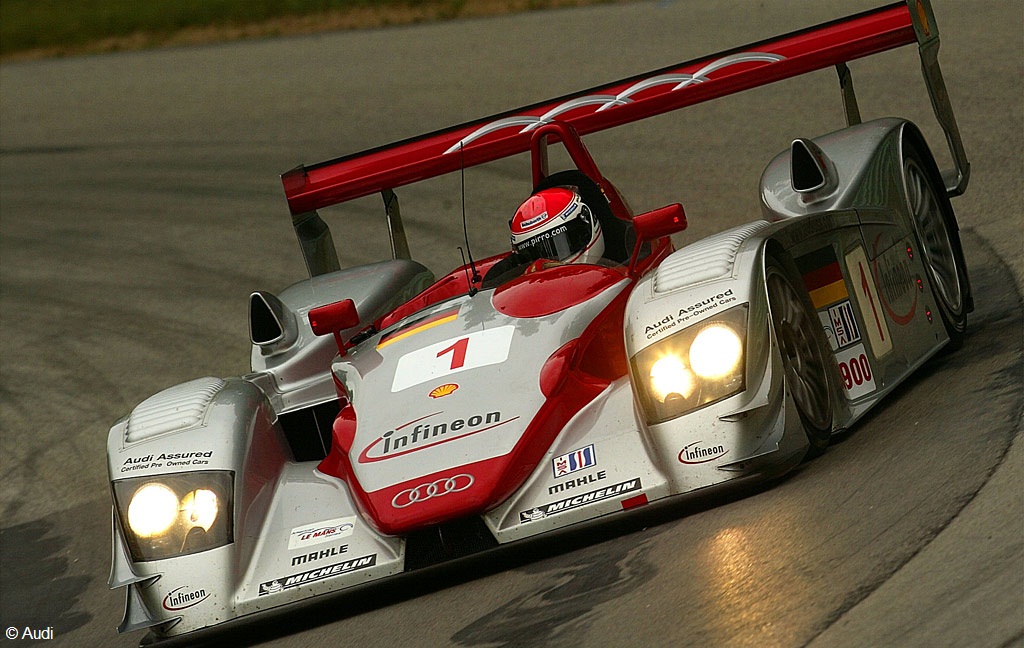
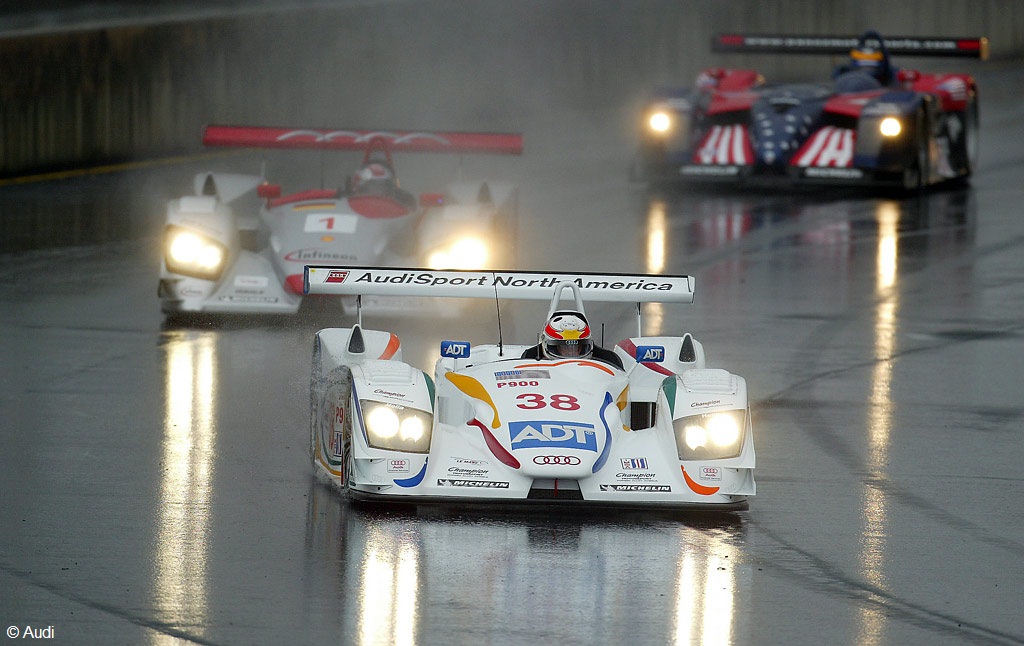
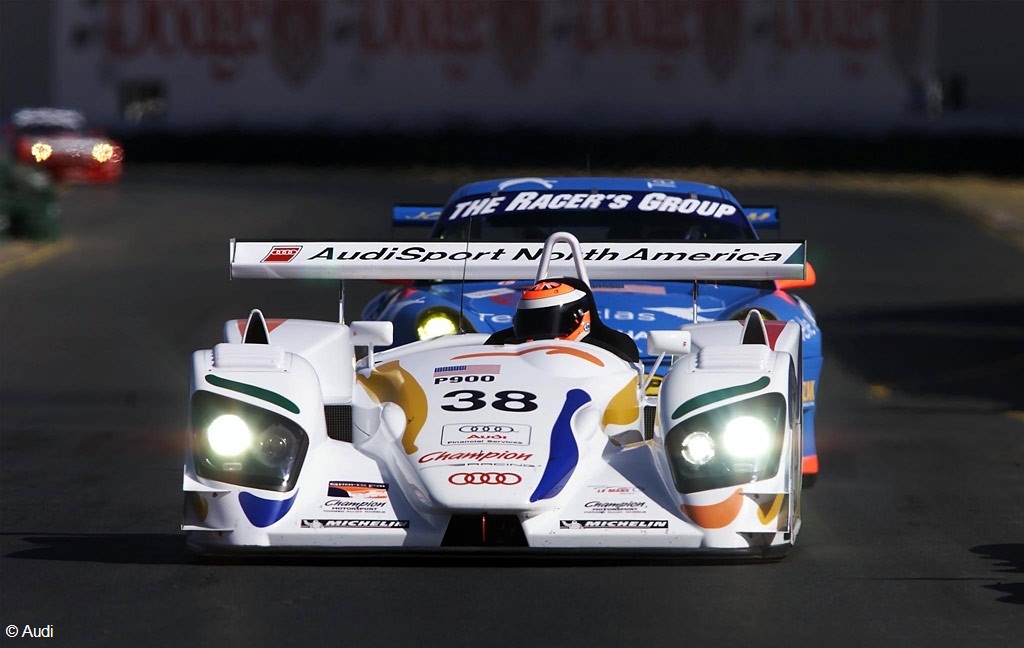
Audi again fielded two cars under the Audi Sport North America banner, managed by the brand's partners Team Joest. For the regular ALMS races the line-ups were Frank Beila and Emanuele Pirro with the #1 Audi R8, and Dindo Capello and Tom Kristensen shared the #2 car. In addition of the two works cars, a single privateer Audi R8 had been entered from Champion Racing.
The 2002 ALMS season consisted of a ten-round calendar. The opening event was the 12 Hours of Sebring, the 50th edition of Florida's classic that year. Audi dominated the event and scored a perfect 1-2 in the end. Dindo Capello, joined for the event by Christian Pescatori and Johnny Herbert, won the race ahead of the customer Audi R8 from team Champion Racing with drivers Stefan Johansson, Jan Lammers and Andy Wallace.
The next event was in California at Sonoma. The race was close to the Le Mans 24 Hours, therefore Audi entered a single factory Audi R8 in event, along with the Champion Racing entry. The new factory Audi R8 cars were in Europe being prepared for Le Mans, thus the Team Joest entry was a 2000 Audi R8, which was borrowed from Champion Racing, the car used by Champion in the 2001 ALMS. It was a very hard race in which Audi was beaten by Panoz for the first time in the season. After the annual break for the Le Mans 24 Hours, and the prefect 1-2-3 win for Audi, the series resumed at Mid-Ohio. Again Audi faced very strong competition from the Panoz cars, yet the German team was able to achieve their second race win of the season. Biela and Pirro took the race win ahead of their team-mates Capello and Kristensen.
Road America was home of the fourth round. There the Audi squad fully dominated the event with a nice 1-2-3 win. After a fierce battle between all three R8s, it was the #2 Audi of Kristensen and Capello that came home victorious. The series then moved to Washington DC, a street course event in which Panoz beat Audi again. The works Audis were second with Capello and Kristensen and third with Biela and Pirro.
The series then crossed the border for two Canadian events. First it was the Grand Prix of Trois Riviéres, with full Audi domination. The R8 cars were first, second and third, with the #2 Audi of Kristensen and Capello as the winning car. The same drivers won again in the next event at Mosport, ahead of the customer Audi from Champion Racing.
Back in America, the eighth round of the season was at Laguna Seca. Another 1-2 Audi victory, with Emanuele Pirro and Frank Biela the race winners. The ninth and penultimate round of the season was in Florida, downtown Miami. Pirro and Biela scored a second straight victory, and again they were ahead of the privateer Champion Audi team. The season finale was the Petit Le Mans at Road Atlanta. Audi won the event with another 1-2 win, Dindo Capello and Tom Kristensen beat Stefan Johansson and Johnny Herbert, after a titanic battle for race victory.
By the end of the season Audi had again defended all three titles. Tom Kristensen won the driver's championship by just two point over teammate Dindo Capello. Audi Sport North America won the team's title and Audi was again the manufacturer champion. 2002 was a very successful year for Audi in the American Le Mans Series, however it was the final time as a full factory effort with the R8. As of the 2003 season, the Audi R8 would be managed by privateer teams only. Audi said goodbye to the ALMS, but the R8 legacy in North America was far from being over.
The American Le Mans Series had a special season finale in the year 2000. The ALMS moved Down Under to Australia, for a race at Adelaide. The event was held on new year's eve, and was called the "Race of a Thousand Years". Audi entered a pair of factory Audi R8 LMP cars. One of them carried a very special livery. The #77 Audi R8 shared by Dindo Capello and Allan McNish had a great paint scheme as a tribute to Australia. The car known as the "Crocodile" Audi R8 won the event in the end.
Here is a great recreation of that stunning livery in Forza Motorsport 4. The design was made by RaptorGhost54 from the French Forza Motorsport community. The result looks great and very close to the real life car.
Part two of Audi's legacy in the American Le Mans series, focusing this time on the 2001 season. The year 2000 was a magical season for Audi, winning the driver, team and manufacturer titles. For 2001 the target was to defend the three crowns and bring them back to Ingolstadt.
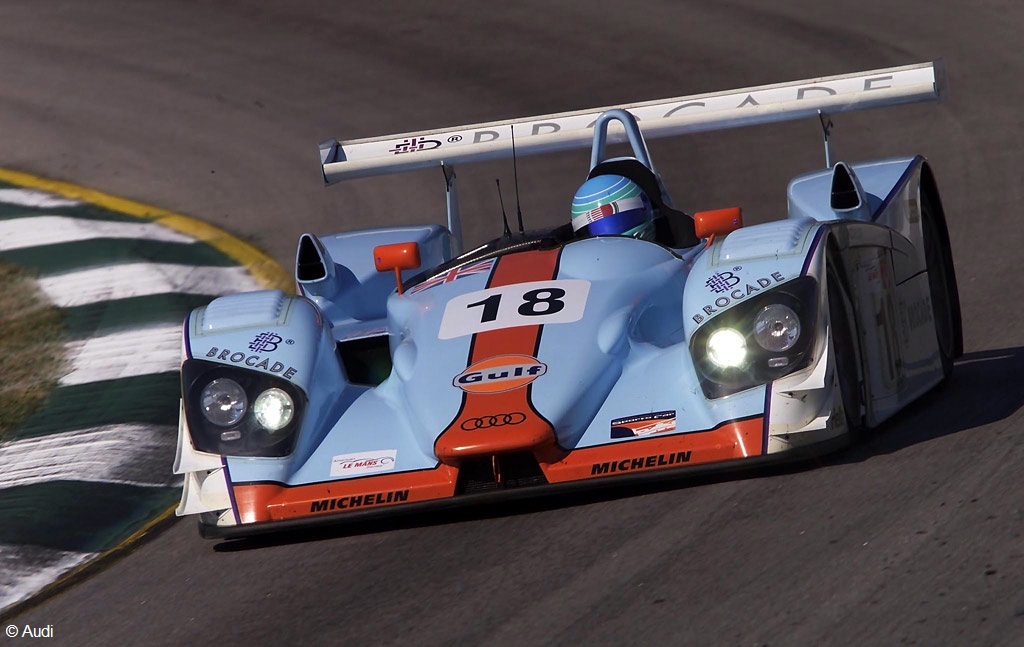
Big changes for 2001, the driver champion, Allan McNish, had left the series and Audi for Formula One with Toyota. BMW Motorsport left the upper LMP900 class, withdrawing their BMW V12 LMR, and entered the production based GT class. And for the first time since Audi's sportscar program debuted, customer teams fielded the Audi R8. Champion Racing from Florida and Johanson Motorsport (Arena) from the UK, each with a one-car effort. The customer teams were armed with one-year old and ex-factory Audi R8 cars from 2000.
Audi's main challengers were the strong Panoz Motorsports effort along with Cadillac, a factory team from GM Racing. Audi entered two works cars under the Audi Sport North America banner, which were again managed by Team Joest. The #1 Audi for Tom Kristensen and Dindo Capello, and the sister #2 R8 for Frank Biela and Emanuele Pirro.
The 2001 American Le Mans Series consisted of a ten race calendar, with two events being held in Europe. The season opener was set at Texas Speedway, Audi won the event with a fine 1-2 victory for the factory team. The race win went to Tom Kristensen and Dindo Capello. The next round was the prestigious 12 Hours of Sebring. Audi dominated Florida's classic with an impressive 1 2 3 4 win. The Audi of Dindo Capello, joined this time by Laurent Aiello and the late Michele Alboreto, won outright ahead of the sister Joest car, whilst the customer teams Champion Racing and Johansson Motorsport finished in third and fourth.
Later the ALMS field moved to Europe for two meetings. The races were combined events between the ALMS and ELMS (new European Le Mans Series). Round 3 was at Donington Park with Audi again dominating. A 1-2-3 win with the #1 Audi R8 of Tom Kristensen and Dindo Capello victorious. At Jarama in Spain for round 4, Kristensen and Capello did it again beating their teammates Biela and Pirro.
After the summer break for the Le Mans 24 Hours, where Audi scored a 1-2 victory, the series went back to North America. Sonoma, California hosted the fifth round of the season. Audi won the event with Capello and Kristensen finishing first. The next event was at Portland with a surprising result in the end. Panoz beat Audi for the first of the season. Frank Biela and Emanuele Pirro finished second. For round seven, the series headed up north to Canada, Frank Biela and Emanuele Pirro won the race at Mosport. At Mid-Ohio, Panoz again beat Audi. Tom Kristensen and Dindo Capello ended second with the #1 R8. The series then returned back to California at Laguna Seca. Frank Biela and Emanuele Pirro won the race, a 1-2-3 for the Audi R8. The season finale was at Petit Le Mans at Road Atlanta and again it was an all Audi affair. The factory Audi R8 of Frank Biela and Emanuele Pirro won ahead of the customer Audis from Johansson Motorsport and Champion Racing.
The 2001 American Le Mans Series gave Audi great satisfaction. Eight race wins and all three titles were successfully defended. Emanuele Pirro won the driver's title in the #2 Audi R8, followed by his teammate Frank Biela in the standings. Their teammates Dindo Capello and Tom Kristensen were third and fourth respectively. Audi Sport North America again won the team's title and Audi again secured the manufacturer's trophy. Great satisfaction also for the privateers Johansson Motorsport and Champion Racing. Both teams performed very well all season long, and the Johansson Motorsport squad was crowned champions of the ELMS. For 2002, Audi would again join the ALMS, but for the last time as a full factory effort with the R8.
The Audi R8 LMP will forever be a legend. After six years of competition the old girl was still competitive, and running at the front in international sports car racing. The car won a staggering 63 races from 80 starts, making it one of the all time great race cars. Its eightieth, and final race, was at Lime Rock during the 2006 ALMS season. It was the last official race for the R8 in an international sports car series before the permanent introduction of the Audi R10 TDI. At the final race the R8 competed in a very special livery that had a list of all the drivers that had won in a R8, all the tracks at which it had won and all the championships and Le Mans titles. The race was extremely exciting as Allan McNish and Dindo Capello battled with much faster and newer machinery from the opposition. Despite the opposition’s speed, the Audi R8 soldiered its way to the front and closed of its racing career in the only way this car knew how, by winning.
Below is the full race broadcast from Lime Rock 2006, the Audi R8’s last race and victory. This video is part of an exciting series of videos on the official ALMS YouTube channel, where they are posting full race broadcasts from the past, well worth a look. Enjoy the race:
14 years have passed since Audi competed at Le Mans for the first time. The first LMP sports car in 1999 was an Audi R8R. Today, the brand relies on the Audi R18 e-tron quattro. There is a world of difference between these two models. Dr. Martin Mühlmeier, Head of Technology at Audi Sport, has accompanied the development of the sports prototypes back then and today. A look beneath the carbon fiber skin of the race cars brings back memories of exciting developments in all areas.
Not even the mathematical calculation methods have remained the same,” says Dr. Martin Mühlmeier, Head of Technology at Audi Sport, recalling the transition period shortly before the start of the new millennium. Until 1998, all Audi race cars were still based on steel structures. Except for the 1989 Audi 90 IMSA GTO, all rally models and touring cars were directly derived from production models. “The 1999 R8R was our first concept with a stressed CFRP structure. This material exhibits a completely different behavior. While metallic materials bend or break in a crash, carbon fiber collapses. Consequently, the calculation methods used here are totally different.”
In the early phase, Dallara assisted with their experience. The Italian company acquired its expertise over many years as a constructor of ‘monoposti’ (open-wheelers) and sports prototypes. “Audi Sport subsequently entered the field of CFRP on its own,” Dr. Mühlmeier goes on to explain. “We implemented this know-how, strengthened our resources by recruiting highly skilled personnel and developed proprietary calculation methods. This soon made it possible for us to calculate structures, strength and crash behavior in-house.”
When comparing the 1999 R8R and the R18 e-tron quattro, 14 years of progress in all areas become evident – starting on the outside. The first car featuring a roadster concept, which laid the foundation for the ‘R’ being used in the name of the ‘R8’ model range abbreviation, looks pretty plain by today’s standards. But how can progress be measured?
Dr. Mühlmeier cites weight as an impressive example: “With the R8R we met the prescribed minimum weight of 900 kilograms with relatively high accuracy. Today, an R18 e-tron quattro that tips the scales at 915 kilos weighs almost the same. However, it is powered by a diesel engine, which is heavier due to its basic design, has a closed cockpit and contains a complex hybrid system. Still, it remains below the minimum weight. That’s why we can work with ballast weight on the set-up.”
How are such major strides achieved? “When we were developing our first car, a steel roll bar was typically used,” recalls Mühlmeier, who has a PhD in engineering. “As of 2000, an integrated CFRP roll bar was implemented. Since 2011, we have been fielding the R18 with a closed monocoque that is completely made of CFRP and features a one-piece design.” In the case of the body, a lot has changed as well. The first skin was designed for relatively high robustness and permitted severe body contact in duels. Now, the body consists of a very thin-layered carbon construction. The steering system is another example. In 1999, power steering was still a hydraulic system supported by the engine. Since the R10 TDI, which made its debut in 2006, the driver’s work at the wheel has been electrically assisted.
ultra-lightweight design, which achieves significant savings in current Audi production models, is desirable in all areas of racing. The suspension of the LMP sports prototypes has become notably lighter. The lithium-ion battery that has been used since the 2009 R15 TDI saved 7 kilograms of weight compared with a lead battery. One of the major single steps the engineers achieved concerned the carbon fiber transmission: Since 2012, Audi has been saving a double-digit number of kilos in just one step.
At the same time, the engineers improved the efficiency of the entire race car. Aerodynamically, the R18 e-tron quattro is a lot more efficient than the first model. Engine technology has even seen true leaps in efficiency. Not only the switch from gasoline to diesel engines in 2006 represented a major step, as the current V6 TDI engine makes very favorable fuel consumption possible. More than 20 percent fuel savings have been achieved in the diesel era. Next season, a fundamentally different set of regulations will place an even greater focus on efficiency.
But Audi has not only clearly progressed in terms of technology but also with respect to manpower. Today, a total of 250 employees are working for Audi Sport at the Ingolstadt and Neckarsulm locations. Under the direction of Audi Head of Motorsport Dr. Wolfgang Ullrich, they take care of the factory-backed motorsport commitments in the DTM and in the FIA World Endurance Championship (WEC). For 2013, new responsibilities have been established. Dieter Gass, as Head of DTM, is responsible for the program with the Audi RS 5 DTM. Chris Reinke, as Head of LMP, manages the sports car program with the Audi R18 e-tron quattro. Both report directly to Dr. Ullrich, who has overall responsibility for all factory-backed programs.
The development of the seven generations of LMP race cars
Audi R8R (1999) On its debut, Audi opted for a conventionally designed sports car. A V8 bi-turbo unit powered the mid-engine race car. Its water radiators were installed at the front. At both the Sebring 12 Hours and the Le Mans 24 Hours, Audi celebrated a podium finish with the roadster. Its opponents at La Sarthe back then were the factory teams of Mercedes-Benz, Nissan, Toyota, BMW and Panoz.
Audi R8 (2000–2005) Audi’s so far most successful sports prototype owes its list of 63 victories in 80 races to its concept, as well as to its long life. Five of the sports car’s six runs at Le Mans ended in victory, despite increasingly severe limitations imposed on power and performance by the regulations. In addition to constant further development of aerodynamics, the engine changed as well. In 2001, TFSI gasoline direct injection made its debut.
Audi R10 TDI (2006–2008) Unbeaten – this is the strong track record of the Audi R10 TDI at Le Mans. Visually, the revolutionary car still bore some resemblance to its predecessor, the R8. But the V12 TDI engine with more than 650 hp was a pioneering achievement. From the cooling system to the wheelbase, from the axle load distribution to the aerodynamic concept, every area was affected by the diesel revolution.
Audi R15 TDI (2009–2010) Audi’s last open sports car to date secured its entry in the history books. In 2010, Audi set a new distance record with the innovative roadster at the Le Mans 24 Hours. Its V10 TDI engine paved the way for VTG turbocharger technology in racing, its lithium-ion battery and LED high-beam headlights rang in a new era in other areas as well.
Audi R18 TDI (2011) Audi ultra-lightweight technology was embodied by the R18 TDI in an exemplary way. The engineers created a lot of reserves for ideal positioning of ballast weight. Thus, the sports car powered by a V6 TDI engine excelled in delivering well-balanced handling. The closed sports car won one of the most thrilling Le Mans races in recent history with a 13.854-second advantage.
Audi R18 e-tron quattro (2012) Visually a close relative of the R18 TDI, the R18 e-tron quattro carried the next revolution under its bodywork. The V6 TDI engine continued to drive the rear wheels. A hybrid system at the front axle completed the powertrain. A flywheel accumulator stored the recuperated energy and supplied it to the front wheels again on acceleration. The prototype immediately won the race.
Audi R18 e-tron quattro (2013) In 2013, Audi is relying on an evolution of the revolution. The hybrid sports car has a more efficient hybrid system, new details and modern assistance systems such as the digital inside mirror and LED headlights with matrix-beam technology. Specifically for Le Mans, Audi has developed a new overall aerodynamics concept. The long-tail body catches the eye. Now, the bodywork is flush with the rear wing.
Audi Sport Team Joest conducted extended tests with the Audi R18 e-tron quattro cars at Sebring last week. During the tests four of the older Audi R8 LMP cars also took part, run by their respective teams. Below we have embedded an onboard video from one of the R8s at the Sebring tests. It was great to have the older Audi R8s alongside the latest Audi prototypes. The Audi R8s were being tested and ECU maintenance was conducted. The R8s present included chassis: #405; #605; #606 and #607.
The video features the Audi R8 owned by Rogers Motorsports, chassis #607 (Car #38 in the Champion Racing livery). The car was driven by Doug Smith.
By Tarek Ramchani Since the debut of the Audi sportscar program with Le Mans prototypes, the German brand has almost always competed at the prestigious 12 Hours of Sebring.
It all started back in 1999, with the all new Audi R8R. The car didn't win but took an honourable third overall. A year later, Audi's Sebring winning legacy started with the Audi R8. The car gave Audi six straight outright wins at Florida's classic from 2000 to 2005. In 2006 a brand new car and new technology debuted at Sebring, the Audi R10 TDI. The car was immediately victorious, winning the race in both 2006 and 2007. The Audi R15 TDI continued a long legacy of Audi cars winning on their debut when Audi won in 2009, and they repeated the debut win with the arrival of the R18 TDI in 2012. The victory last year marked the tenth overall Audi win at Sebring. The 2013 Sebring 12 Hours will be the last LMP1 Sebring, and Audi wants to take their eleventh overall victory as a swansong with the Audi R18 e-tron quattro. Here is a complete round up of the ten outright victories of the Audi brand at Sebring. 2000: The race debut of the legendary Audi R8. Two cars entered the 12 Hours of Sebring in 2000. With strong competition coming from Panoz and mainly from the 1999 Le Mans winners BMW with their V12 LMR. Audi won the race with a fantastic 1-2 victory for Audi Sport Team Joest. The winning drivers were Emanuele Pirro, Frank Biela and Tom Kristensen. Second and finishing on the lead lap, the #77 Audi R8 with Allan McNish, Dindo Capello and Rinaldo Capello.
2001: For 2001, no less than four Audi R8 cars entered the 12 Hours of Sebring. Two fielded by the factory Audi Sport Team Joest and the others were privately run cars from Champion Racing and Johansson Motorsport. A stunning 1-2-3-4 Audi win. Victory went to the #1 Audi R8 driven by Dindo Capello, Laurent Aiello and the late Michele Alboreto. Again the sister car finished on the lead lap, the #2 Audi of Emanuele Pirro, Frank Biela and Tom Kristensen.
2002: The 2002 race was the final one for Audi as a full factory team with the Audi R8. Three cars entered the race. Two fielded by Audi Sport Team Joest and the third a privateer car from the American team, Champion Racing. The Audis battled with each other, but also had to attend to the strong Panoz team and the growing competitors of Team Cadillac. After a much fought race, victory went to the #2 Audi in hands of Dindo Capello, Christian Pescatori and Johnny Herbert. The #38 Champion Racing car finished in a strong second place, a lap behind the winning car, with drivers Andy Wallace, Jan Lammers and Stefan Johansson.
2003: The 2003 season and a new era for the Audi R8. With the full factory Audi Sport program being over, all the teams were privateers on both sides of the Atlantic. For the 12 Hours of Sebring three Audi R8 cars were entered. Team Joest. Champion Racing and Audi Sport UK each fielding a single car. The factory Team Bentley also entered the race with their new Speed 8 GTPs. After a titanic battle between Joest Racing and Champion Racing, the German team was victorious. The #1 Audi R8 took race win with drivers Frank Biela, Marko Werner and Philip Peter. The #38 Champion R8 finished in second on the lead lap with Emanuele Pirro, JJ Lehto and Stefan Johansson.
2004: For 2004, Joest Racing stopped their sportscar efforts after four straight victories at Sebring. Three Audi R8 cars entered the 12 hour race. Two from Audi Sport UK Team Veloqx, and a single car from Champion Racing. The three cars gave Audi a clean 1-2-3 win. Victory in the end for the #28 Audi R8 of Audi Sport UK Team Veloqx with drivers Allan McNish, Pierre Kaffer and Frank Biela. Champion Racing with Emanuele Pirro, JJ Lehto and Marco Werner finished in second, but five laps down from the winning car.
2005: The final race of the Audi R8 at the 12 Hours of Sebring. Only two cars entered the 2005 race. The two Audi R8s from team Champion Racing, the reigning ALMS champions. While facing a very small field of LMP1 competitors, the two Champion R8s battled with each other during the whole race. In the end a 1-2 victory with the #1 machine taking the overall win with drivers Tom Kristensen, JJ Lehto and Marco Werner. The #2 Audi was driven by Allan McNish, Emanuele Pirro and Frank Biela. A few months later, the Audi R8 won its final ever race at Le Mans 24 Hours.
2006: A new car and a new technology. Audi made history by debuting in and winning a major international race with a Diesel powered race car. Audi Sport Team Joest was back to Sebring as a full factory team, the only American race for them, as they were preparing Le Mans 24 Hours. The brand new Audi R10 TDI stormed Florida's race taking victory with the #2 car of Allan McNish, Dindo Capello and Tom Kristensen. The #1 Audi failed to finish, the car was driven by Emanuel Pirro, Frank Biela and Marco Werner.
2007: The Audi R10 TDI was back to defend its 2006 crown. Two cars entered by Audi Sport Team Joest (under Audi Sport North America name). Once again the competition wasn't that strong in LMP1. The challenger this time came from the lower LMP2 cars, with factory teams from Porsche and Acura. The Joest team won the race in the end with the #2 Audi R10 TDI of Emanuele Pirro, Frank Biela and Marco Werner. The sister #1 car driven by Allan McNish, Dindo Capello and Tom Kristensen faced some problems and finished fourth overall, 11 laps behind the winning car. This is the last victory for the Audi R10 TDI at Sebring.
2009: In 2008 Audi failed to win Sebring for the first time since 2000. The victory went to Penske Racing and their Porsche RS Spyder LMP2 machine. For 2009 Audi Sport replaced the three year old Audi R10 TDI with the new LMP1 challenger, the Audi R15 TDI. Yet again the race debut for the new car was at the 12 Hours of Sebring. Peugeot and new comers from Acura in the top LMP1 class were the rivals to beat. The race against the Peugeots proved to be one of the most fought for Audi in Florida. In the end the #2 Audi R15 TDI won the race overall with drivers Allan McNish, Dindo Capello and Tom Kristensen, just ahead of the second placed #08 Peugeot 908. The sister #1 Audi of Lucas Luhr, Marco Werner and Mike Rockenfeller finished in third, 2 laps down.
2012:
After a two year drought at Sebring, Audi Sport Team Joest arrived with the Audi R18 TDI in 2012. Armed with three cars they were determined to reclaim victory at the legendary endurance event. The Audi R18 TDI cars proved to be the class of the field and qualified 1-2-3, a position which they held for most of the opening hours. Various issues dropped the #1 car down the field, driven by Marcel Fässler, Benoît Tréluyer and Andre Lotterer, who ultimately finish 16th overall, 15 laps down. The race came down to a duel between the #2 Audi R18 TDI (Dindo Capello, Tom Kristensen and Allan McNish) and the sister #3 car of Timo Bernhard, Romain Dumas and Loic Duval. The team mates battled for hours but in the end the #2 crew came home to win the race, leading an Audi 1-2. They won the race by 4 laps, securing Audi's tenth overall Sebring 12 Hours victory.






.jpg)


